The Virality Of The Miami Boys Choir
An Orthodox Jewish favorite hits the mainstream
Hi, it’s been a very long while. I have been planning to start things up again and am actually in the middle of writing a newsletter that will attempt to explain my prolonged absence but I wanted to send this one out first while the topic is still somewhat timely.
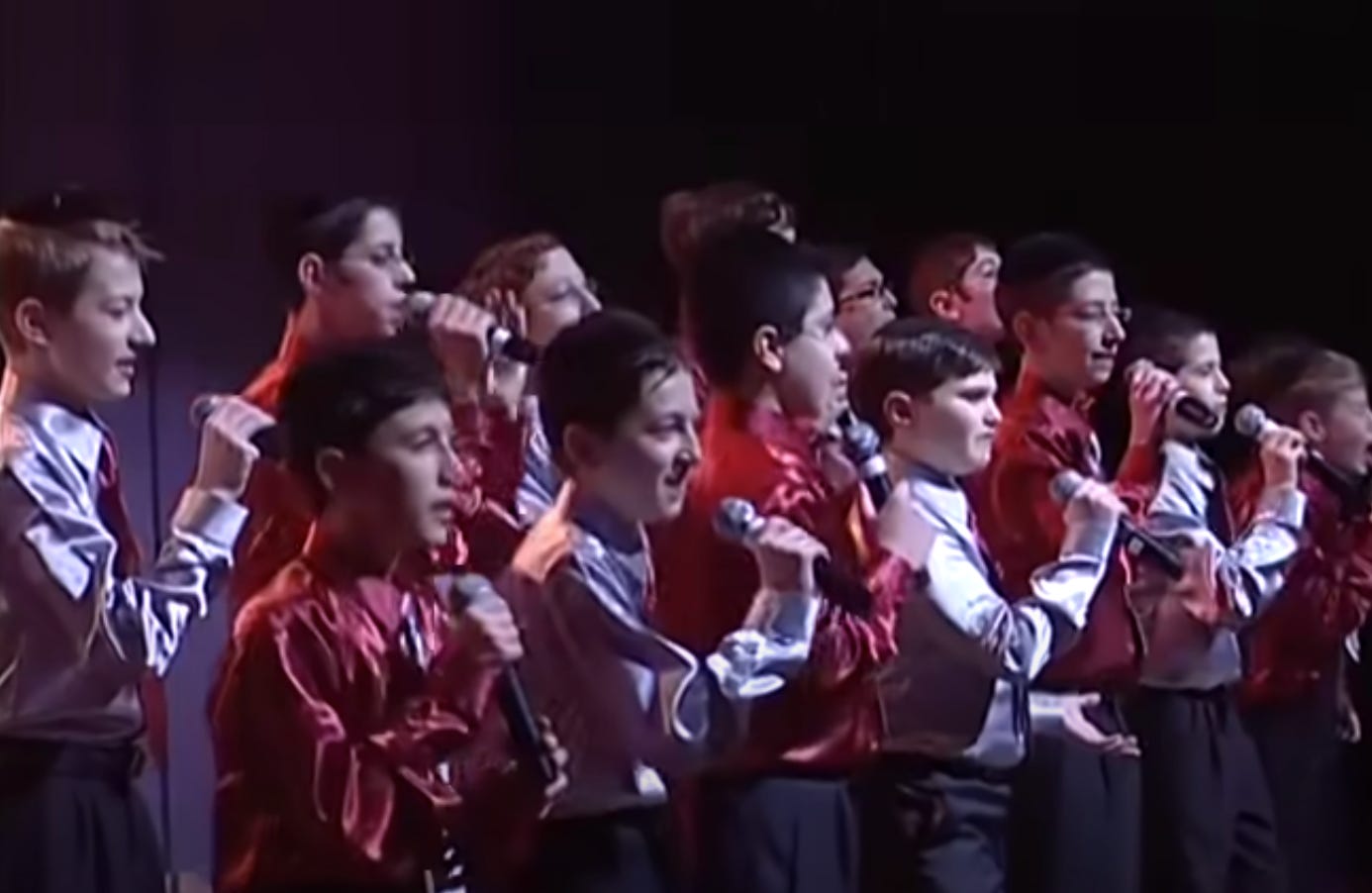
Last week, I woke up to the news that Miami Boys Choir, an Orthodox Jewish singing group that has been around since the late 70s with a rotating cast of young male singers—as with Menudo, the boys tend to leave when their voices change—has become something of a viral thing on TikTok.
I grew up listening to Miami Boys Choir. Well, I listened to a lot of things. My family’s approach to the consumption of music, TV, and movies was very much a “Yes and.” So yes to Jewish music and yes to secular music on the radio and to TV shows—even those with adult themes—and to any book I wished to take out of the library. So for me, Miami Boys Choir was part of a varied musical diet though for others, it, and other Jewish groups just like it, might be all that they listened to.
I can’t be certain because I’ve consumed much weed, primarily in edible form, over the last few years, but if MBC wasn’t the first concert I went to, it was definitely one of the first. (I have vague memories of going to some oldies outdoor concert in Brooklyn with my parents and sister where we sat on beach chairs prior to seeing MBC live.)
The fact that Miami Boys Choir, which was created by Orthodox Jews for Orthodox Jews, has moved beyond its intended audience into the viral mainstream is blowing my mind. Not that I’m mad—not at all—about it but can someone please explain why a bunch of young frum boys wearing shiny shirts and ties and doing somewhat synchronized steps while singing about Hashem has mainstream appeal? I asked a non-Jewish friend who responded, “It’s the pipes! The beautiful singing voices have captivated a nation.” If I had to hazard a guess as to why people outside the Orthodox community seem drawn to MBC, at least for the moment, it probably also has something to do with the awkward sincerity of the performers. A “career” in MBC was always going to be a short lived affair and there wasn’t an adult Jewish pop star machine to plug these guys into after their time in the choir was over. (Though there are definitely some male adult Jewish singers of some renown.) This is different from the young men who populated mainstream boy bands that I also listened to and enjoyed when I was younger. Those singers were generally older than MBC members with more training; they were clearly being prepared for big pop careers that were meant to last several years, well into adulthood, if possible.
Here’s Jaya’s response to my question of “Why???”
And, as many comments I read noted, “Yerushalayim,” the song from the clip that has gone viral, is a “bop.” People of all backgrounds and faiths love a bop.
I think part of what amuses me about something like the Miami Boys Choir taking off, however briefly, in the mainstream is the fact that those of us who consumed this stuff and were also exposed to secular pop culture did so with the sense that perhaps our own products were simply not as good as the stuff created by the mainstream media. Never in a million years would I have considered sharing a Miami Boys Choir song with a secular friend. My best friend who lived down the block from me wasn’t Orthodox and together we listened to Paula Abdul and sang songs from The Little Mermaid. (She was also into New Kids on the Block but I couldn’t get into that.) And at some point, probably around 11 or 12, the age of many of some of the boys in the choir, I stopped listening to MBC. I had outgrown it.
In Blue Fringe’s “Flippin’ Out,” a winking song about spending the year after high school studying in a yeshiva in Israel and becoming more extreme in one’s religious observance, the lyrics signal a distaste for music like MBC’s.
They sing:
“No more English music because she might be pretty/
Now it’s only Carlebach and Miami Boys/
That’s all the __ that I used to call noise.”
Here they’re talking about becoming so religious that they no longer feel comfortable listening to secular music—there is a prohibition against listening to women over the age of 12 sing but that’s a story for another time—so they now have to resort to music that they had previously disdained like MBC.
Some have taken to jokingly referring to MBC as the Jewish equivalent of K-pop, O-pop if you will. (Thanks Jaya.) There are also several videos of people sorting the four main soloists in the more than decade old clip into their One Direction equivalents. The clip that TikTok seized upon is actually more than a decade old so the young singers that the Zoomers are stanning are actually men in their 20s with wives and jobs. And all of them seemed to be getting a kick out of this unexpected dose of fame.
Here are some of the TikTok responses from the featured soloists in the “Yerushalayim.”
It’s kind of nice to see MBC through the eyes of people outside the Orthodox Jewish community and watch them enjoying it. It has given me the opportunity to reconsider these songs and appreciate them for what they are instead of focusing on how they differ from mainstream pop songs as I often did when I was younger. From an elder Millennial, thank you Zoomers.
While we’re on the topic of MBC, I want to talk about this song, “B’siyata D’shmaya,” which was a huge hit for them when I was young. I definitely had the cassette and listened to it a lot.
I want to focus on the chorus of the song because that was what ended up being hilariously parodied at the sleep away camp I attended every summer all throughout the 90s.
The original chorus:
“B’syata d’shmaya/Whatever I do.
When I need Him to help me/He’ll always come through.
Never will I be alone/With His help, I can stand on my own.”
And the parody version that I remember learning:
“Cause I’m shomer negiah/So leave me alone.
If you wanna reach out and touch me/pick up the phone.
Stay on your side of the line/cause this body is exclusively mine.”
(Any other olds out there get the Bell Telephone reference?)
Now for a little translation. “Shomer negiah” refers to the rule prohibiting any sort of physical contact—including casual contact—between unmarried, unrelated members of the opposite sex. While this was certainly talked about in my all-girls yeshiva, the first place I remember this concept being stressed was actually at the all-girls camp I went to, which is odd when you think about it. During those almost six weeks I spent in the Catskills every summer, the chances of finding a young man to touch were virtually nil. (My summer camp experience was definitely not like Wet Hot American Summer.) There was only a smattering of men at the camp. A few rabbis who worked there and non-Jewish workers who rarely interacted with campers in any capacity and were not, to my recollection, young enough to be objects of romantic fancy. While sex segregation was also a thing back home, at least there were young men of dating age kind of around—your friends’ brothers and their friends, boys you could plausibly meet at the kosher pizza store or merely around.
Anyway, in Artifacts of Orthodox Jewish Childhoods, which was edited by Dainy Bernstein, there’s an essay written by Talia Weisberg about the Shomer Negiah song. She traces its origins to Camp Sternberg, which was surprising to me. I know that I learned it at camp but until I read this essay, I never entertained the possibility that it had originated at Sternberg. She didn’t figure out exactly when it was parodied but it had to have happened at some point after 1984, which is when the MBC original came out. I didn’t arrive at the camp until the summer of 1991 and I was eight years old so I probably learned a few years after my first camp trip since I wouldn’t have gotten the joke at that age. I don’t think I was even aware of the concept of shomer negiah yet. (The lyrics that Weisberg recounts aren’t exactly as I remembered singing them though she acknowledged that there was some fluidity in the verses and I recounted them above as I sang them when I was younger.)
In what was perhaps my finest—or most humiliating moment—I actually sang those verses in front of Fiona Apple many years after learning them at Camp Sternberg. It was during my first semester of my Creative Writing MFA program. Typically after the workshop, most of the writers went to a bar near school along with our professor to drink and chat. Well, Fiona was dating my professor so on one occasion, she joined us. The week before after class at the same bar, a few of my classmates who came from extreme religious backgrounds were swapping war stories and I had sung the Shomer Negiah song to peals of laughter from the group, which was precisely the reaction I had been hoping for. Well, the following week with Ms. Apple, who was shy and brilliant and lovely in person, one of my classmates whispered in my ear, “If you sing that song, I’ll buy you a drink.” I was very broke in those days, which is also how I find myself at the moment but it was even worse back then, so I agreed to those terms.
I looked at Fiona, whose albums I bought in high school and college and had practically memorized, and apologized for what I was about to do. I’m a perfectly adequate singer and can carry a tune just fine, but here I was about to sing a ridiculous little ditty in front of the Fiona Apple. I was quite nervous. Anyway, I did it, everyone laughed, and I got a glass of wine. For a while after, I joked that if a song about not touching men was on any of her subsequent albums, I’d demand a co-writing credit even though I hadn’t actually written the verse I had sung. (Weisberg’s essay didn’t name a writer or a group of writers for the parody.) To my knowledge, Fiona hasn’t ever produced a song about not touching men for religious reasons. I doubt that she ever will because it’s unlikely she remembers a semi-drunk lowly grad school writing student who sang something silly in a bar one night. But I’ll never forget it. I peaked in life that night. It's been downhill ever since.
While I’ve been out of communication with you guys, I’ve published a handful of stories, some of which I’m even proud of. I’ll highlight a few of them here.
I did some work for FiveThirtyEight for the Winter Olympics and I got to write about the history of gender segregation in figure skating and Madge Syers; about the glory that is Jason Brown; and about Kamila Valieva’s positive drug test result and what it means for how we talk about abuse in skating and the way we think about the anti-doping regime in general.
I also finally wrote as a feature a topic that had been sitting in the drafts folder of this newsletter for at least a year—about what’s underneath the popular media narrative that women’s college gymnastics is the place where gymnasts go to finally be happy.
And in June for the 50th anniversary of Title IX, I wrote about the inadvertent consequences of the landmark legislation—how it led to reducing the percentage of women coaching women’s programs at the collegiate level.
As I said at the top, I am working on something that will touch on what’s been going on with me, writing, and this newsletter. I hope to publish that soon. Thanks, as always, for your patience and support.


I hadn't seen any of this so thank you for introducing me to MBC! I'm actually glad that the song that's gone viral is from 10 years ago so that the kids involved are now old enough to hopefully just find the whole thing fun/funny. It reminds me a lot of "Friday" by Rebecca Black going viral, only unfortunately she was still young and had to deal with the bad as well as good that came from it. What strange and wonderful things the internet brings to us!
Hope you're doing well Dvora!